Law Firm Website Templates
Build law firm websites that command authority and convert visitors into clients, with practice area expertise, attorney profiles, and case result showcases.
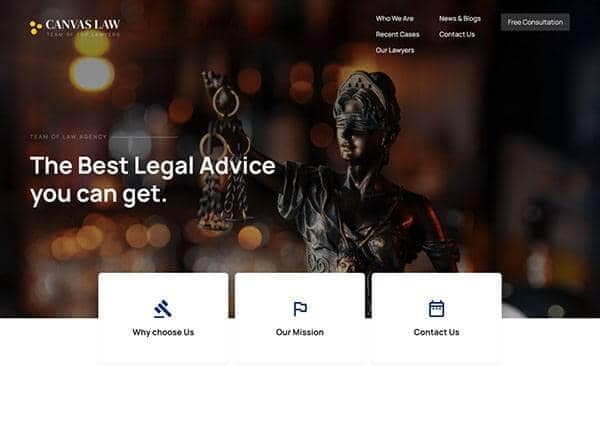
Example output
40
industry templates
1,938+
prompt templates
About 3 minutes
to build a page
Designing a law firm website: what works
Legal websites must project two things simultaneously: authority and accessibility. Clients seeking legal help are often in vulnerable or stressful situations: they need to quickly determine that you have the expertise to handle their matter and that you're approachable enough to actually help them. Design bridges this tension.
Visual Authority Without Intimidation
The classic navy-and-gold law firm palette projects established authority but can feel cold. Modern successful firms balance this with warmer photography, cleaner typography, and accessible language that doesn't require a law degree to understand. The goal is authoritative confidence, not impenetrable formality.
Practice Area Architecture
Practice areas should be immediately navigable from the home page with clear, plain-language labels. Each practice area needs its own landing page: what it covers, who it's for, your approach, relevant case results or outcomes, and attorney bios for that specialty. This structure also drives strong SEO for practice-area-specific queries.
Attorney Profile Depth
Attorney profiles are the highest-traffic pages on most law firm sites after the home page. Include: professional photo, bio emphasising relevant experience and outcomes, bar admissions, education, awards and recognitions, publications, and client testimonials attributed to that attorney. Case results (anonymised where required) add powerful proof.
Client Journey and Intake Design
Many potential clients have never hired a lawyer and don't know what to expect. A 'How we work' section explaining initial consultation, engagement, process, and fee structure reduces anxiety and increases the likelihood of contact. An online consultation request form with a guaranteed response time converts better than a generic contact form.
Ready to build?
Describe your law firm website in plain English and Canvas Builder builds it, ready to edit and export. No design skills needed.
5 design tips for law firm websites
Display case results prominently
Anonymised case outcomes ('$2.4M settlement, personal injury') near practice area descriptions are among the most powerful trust signals in legal marketing. They answer the client's most important question: 'Can you win?'
Offer a free initial consultation prominently
A free consultation CTA removes the highest barrier to contact: fear of immediate expense. Display it in the header, hero, and after each practice area description. Make the form short: name, phone, brief matter description, and preferred contact time.
Use plain English everywhere
Legal jargon in marketing copy signals that you don't understand client communication. Write like a trusted advisor explaining your services to a friend, not like a statute. Plain language builds trust and improves search rankings.
Create local authority content
Blog posts about local court procedures, state-specific legal changes, or community legal issues build local SEO authority and demonstrate genuine connection to the community you serve. These outperform generic 'What is a will?' posts that compete nationally.
Embed a live chat for after-hours enquiries
Legal decisions are often made in evenings and weekends when offices are closed. A chatbot or live chat service that captures name, contact details, and brief matter description can double lead capture outside business hours.
Try this prompt
Use it as it is, or change the names, colours and sections to match your business.
Create a full-page law firm website for 'Hartley & Associates', a boutique litigation firm. Use a sophisticated navy and warm white palette with gold accents. Full header (not transparent). Hero with split layout: left side has 'Protecting What Matters Most' headline, free consultation CTA, and trust badges (40+ years combined experience, $50M+ in settlements). Right side has a confident attorney photo. Practice areas grid (Personal Injury, Family Law, Corporate Law, Criminal Defence, Estate Planning). Senior attorney profiles. Case results section. And a consultation request form.Frequently asked questions
What pages does a law firm website need?
Core pages: Home, Practice Areas (one per specialty), Attorney Profiles, About the Firm, Results/Case Studies, Client Testimonials, Contact/Free Consultation, and a Blog/Legal Resources section. Local offices, if multiple, should have individual location pages for local SEO.
Can law firms advertise case results on their website?
Generally yes, but with mandatory disclaimers ('Past results do not guarantee future outcomes'). Specific rules vary by jurisdiction and bar association guidelines. Always review your state bar's advertising rules before publishing specific dollar figures or outcome statistics.
Should a law firm have a blog?
Absolutely, legal blogs are among the highest-ROI content investments in any professional service. Articles on common legal questions in your practice areas rank for high-intent searches ('Can I dispute a will in [state]?') and capture prospective clients at the moment they realise they need legal help.
How do I improve my law firm's local search ranking?
Four essential tactics: (1) Optimise Google Business Profile with all services, photos, and regular posts, (2) Build citations in legal directories (Avvo, Justia, FindLaw, Martindale-Hubbell), (3) Earn genuine client reviews on Google, (4) Create location-specific practice area pages with genuine local content.
Should I display attorney fees on my website?
For commodity services with predictable pricing (wills, simple contracts), displaying fees reduces friction and pre-qualifies price-sensitive clients. For complex litigation, explaining your fee structure (hourly, contingency, flat fee) with a 'Contact us for a quote' approach is more appropriate.
Related templates
Medical & Healthcare Website Templates
Design patient-first healthcare websites that build trust, simplify appointment booking, and clearly communicate your services and specialties.
View templates →Finance & Fintech Website Templates
Build finance and fintech websites that inspire confidence and convert clients, with regulatory credentials, service clarity, interactive calculators, and the authoritative design financial services demand.
View templates →Consulting Website Templates
Build consulting websites that attract premium clients, with expertise positioning, case study showcases, speaking credentials, and authority-first design that commands higher fees.
View templates →Build your law firm website in minutes
Describe what you need. Canvas Builder writes production-ready Bootstrap 5 HTML on the Canvas design system, ready to publish or export.