Finance & Fintech Website Templates
Build finance and fintech websites that inspire confidence and convert clients, with regulatory credentials, service clarity, interactive calculators, and the authoritative design financial services demand.
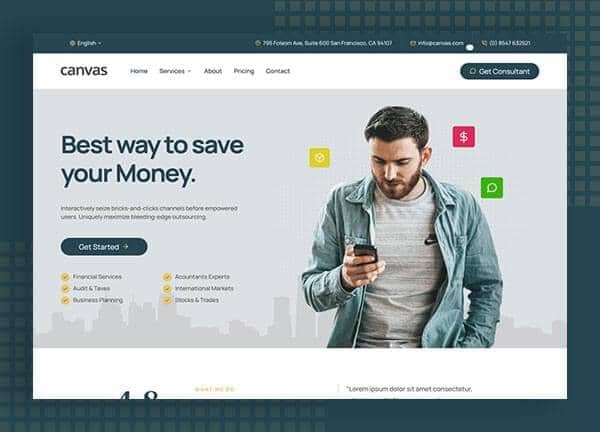
Example output
40
industry templates
1,938+
prompt templates
About 3 minutes
to build a page
Designing a finance & fintech website: what works
Finance websites operate under two intersecting pressures: regulatory compliance requirements that constrain what can be said and how, and intense consumer trust demands that require every design element to project reliability, stability, and competence. In this context, design conservatism is not a failure of creativity: it's a deliberate signal of trustworthiness.
Design as Trust Signal
Clean, professional design with restrained colour palettes (navy, deep green, white, grey) has become the established visual language of financial credibility. Departures from this (overly casual design, trendy visual experiments, or aggressive sales language) undermine the implicit trust claims that financial services websites must make. Refinement signals reliability.
Regulatory Compliance and Disclaimers
Financial services websites in most jurisdictions require specific disclosures: licensee information, regulatory body names, past performance disclaimers, and product disclosure statement links. These must be prominently accessible without cluttering the user experience. A dedicated compliance footer, accessible disclosure links throughout service pages, and AFSL/FCA/SEC registration details are not optional.
Financial Tool Integration
Calculators are the highest-engagement content on financial websites. Loan repayment calculators, compound interest visualisers, retirement savings projectors, and mortgage affordability tools provide genuine utility, keep visitors on site longer, and create qualified leads who have self-identified their financial need. Ensure all calculators display appropriate use disclaimers.
Client Portal and Account Access Design
Existing client portals must be prominently accessible, typically in the top navigation, without dominating the new client conversion flow. Two-factor authentication, bank-level SSL messaging, and clear session security signals on the login interface address security anxiety that financial service clients feel acutely.
Ready to build?
Describe your finance & fintech website in plain English and Canvas Builder builds it, ready to edit and export. No design skills needed.
5 design tips for finance & fintech websites
Lead with specific outcome claims, not vague promises
Specific, evidence-based claims ('Our clients' portfolios have returned an average of 8.3% annually over 10 years') outperform vague superlatives ('Expert financial advice'). Back specific claims with required disclaimers and methodology: specificity with transparency is uniquely credible.
Display all regulatory credentials prominently
AFSL numbers, FCA registration, SEC registration, and professional body memberships (CFA, CFP, ACCA) should be prominently visible on the home page and in the footer. These credentials are legal requirements but also significant trust signals for informed financial consumers.
Integrate financial calculators
Tools that help visitors calculate mortgage repayments, super contributions, or investment growth create qualified leads who've self-identified a financial need. A calculator that ends with 'Talk to an advisor to optimise this plan' is among the most effective lead generation tools in financial services.
Use client story testimonials carefully
Financial service testimonials must comply with your jurisdiction's advertising standards: check regulatory guidelines before publishing. Where compliant, client stories (anonymised if required) with specific outcomes convert significantly better than generic 'great service' reviews.
Make your fee structure transparent
Fee opacity is one of the primary trust barriers in financial services. A clearly explained fee structure (percentage of assets, flat planning fee, hourly rate) builds confidence even if the fees are not the lowest in the market. Clients who understand what they're paying for are more satisfied and less likely to churn.
Try this prompt
Use it as it is, or change the names, colours and sections to match your business.
Create a full-page financial advisory firm website for 'Pinnacle Wealth Advisors', a boutique wealth management firm. Use a sophisticated dark navy and white palette with gold accents. Full solid header. Hero with a confident, lifestyle-focused financial photography and headline 'Wealth That Works For Your Future'. Services section (Investment Management, Financial Planning, Retirement, Estate Planning). An interactive savings calculator. Team profiles with credentials (CFA, CFP designations). Client testimonials with outcome focus. Regulatory compliance footer section. And a consultation booking CTA.Frequently asked questions
What pages does a financial services website need?
Core pages: Home, Services (individual service pages per offering), About the Team, Client Approach/Process, Insights/Blog, Client Login, and Contact. Compliance pages: Financial Services Guide, Privacy Policy, and Disclosure Statement are legally required in most jurisdictions.
What are the regulatory requirements for a financial services website?
Requirements vary by jurisdiction. In Australia: AFSL licence details and FSG must be accessible. In the UK: FCA registration number and status must be displayed. In the US: SEC or FINRA registration details. All jurisdictions require past performance disclaimers on investment content. Always engage a compliance consultant for your specific jurisdiction and licence type.
Should I write financial content for my website without compliance review?
No. Any content that could constitute financial advice (specific investment recommendations, return projections, or comparisons of specific products) must be reviewed by your compliance team or compliance software before publication. Content that provides general financial information without specific advice claims has more latitude, but should still be reviewed.
How do I build credibility for a new financial services firm?
Five high-impact credibility builders: (1) Published team credentials and professional designations, (2) Thought leadership articles in industry publications, (3) Partnership with industry bodies (association logos), (4) PR appearances as an expert commentator in mainstream media, (5) Client testimonials presented compliantly. New firms must work harder on credibility signals: the regulatory credentials alone aren't differentiating.
How important is page speed for a financial services website?
Very important: wealthy or older demographic financial services clients often use corporate devices and networks. Page speed directly affects both user experience and Google search ranking. Prioritise fast-loading pages, avoid heavy animations, and test on both fast and slower connections.
Related templates
SaaS Landing Page Templates
Build conversion-optimised SaaS landing pages with feature showcases, pricing tiers, testimonials, and compelling CTAs, all generated from a single prompt.
View templates →Law Firm Website Templates
Build law firm websites that command authority and convert visitors into clients, with practice area expertise, attorney profiles, and case result showcases.
View templates →Consulting Website Templates
Build consulting websites that attract premium clients, with expertise positioning, case study showcases, speaking credentials, and authority-first design that commands higher fees.
View templates →Build your finance & fintech website in minutes
Describe what you need. Canvas Builder writes production-ready Bootstrap 5 HTML on the Canvas design system, ready to publish or export.