Restaurant Website Examples
The best restaurant websites do one thing above all else: make you hungry. They translate the sensory experience of dining (warmth, atmosphere, taste) into a visual experience that compels visitors to book a table or place an order. Here's what separates great restaurant websites from forgettable ones.
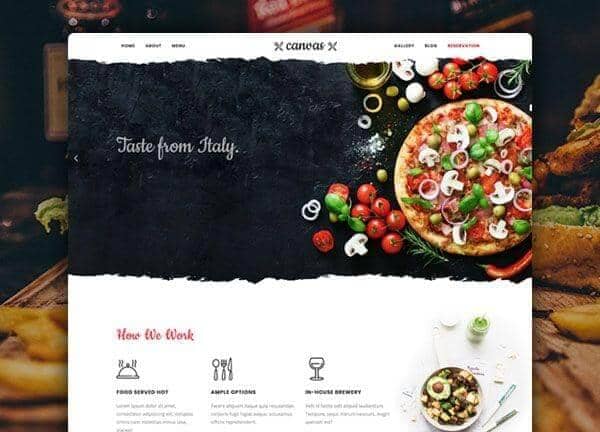
From the Canvas template
The Canvas design system that Canvas Builder builds on
A preview of a Canvas template demo for this niche. Canvas Builder generates new layouts in the same Bootstrap 5 system from your own description, so your page is built for your business rather than copied from a demo.
See restaurant website templatesWhat makes a great restaurant website?
Full-bleed food photography
Top restaurant sites invest in professional food and ambience photography. A single stunning hero image (a perfectly plated dish, a candlelit dining room) communicates quality instantly. No stock photography. No low-resolution phone shots.
Friction-free reservation flow
The reservation CTA appears in the header, the hero, and the footer. Best-in-class examples reduce booking to 2 to 3 clicks: date, party size, confirm. OpenTable and Resy widgets are embedded directly rather than linking to a separate site.
HTML menus (not PDFs)
Award-winning restaurant sites use HTML menu pages with proper headings and prices, not PDF downloads. This makes the menu indexable by Google, readable on mobile, and searchable. Customers find dishes before they find the restaurant.
Location and hours above the fold on mobile
On mobile, the most-searched information is address and opening hours. The best restaurant sites surface this in the header and the hero, not buried in the footer.
Common restaurant website design patterns
The visual styles most commonly used across top restaurant website sites.
Dark hero with warm overlay
Deep navy, charcoal, or black background with a full-bleed food photo and gold/terracotta accent colours. Conveys premium and intimacy.
Used by: Fine dining, wine bars, steakhouses
White-dominant minimalist
Clean white backgrounds, generous whitespace, serif typography, and high-contrast food photography. Signals freshness and quality.
Used by: Bakeries, cafés, health food, farm-to-table
Warm earthy tones
Terracotta, olive, burnt orange, and cream. Evokes Mediterranean, Italian, or rustic cuisine. Usually paired with hand-drawn or serif fonts.
Used by: Italian restaurants, tapas bars, brunch spots
Bold typographic hero
Oversized restaurant name or tagline as the hero element. Photography is secondary: the brand name dominates. Common in brand-forward concepts.
Used by: Trendy urban restaurants, cocktail bars, branded chains
Must-have elements
- Professional hero image (food or dining room)
- Online reservation CTA in the header
- HTML menu (not PDF): indexable and mobile-friendly
- Opening hours visible without scrolling on mobile
- Google Maps embed or address link
- Gallery section showcasing food and ambience
- Social proof (Google rating, press mentions)
- Instagram feed or social links
- Contact form or direct phone number
Common mistakes to avoid
- PDF menus that can't be indexed by Google or read on mobile
- Stock photography instead of real dish photography
- Reservation button only in the footer
- Opening hours only in the footer (not findable on mobile without scrolling)
- No mobile optimisation for the menu section
- Autoplay music or video that fires without user consent
Describe your own restaurant website
Edit the prompt or pick a starting point. Canvas Builder builds it live on the Canvas design system.
Frequently asked questions
What do the best restaurant websites have in common?
Professional food photography, a friction-free reservation flow, an HTML menu (not PDF), and location/hours visible immediately on mobile. The best sites treat every page as a sensory experience that mirrors the actual dining atmosphere.
How much does a restaurant website typically cost?
A custom-built restaurant website costs $2,000 to $10,000+ from a web agency. Using a pre-built HTML template and Canvas Builder, you can produce a production-quality restaurant website for a fraction of that, often under $100 in total tool costs.
Should a restaurant website have its own online ordering?
For delivery volume above 20 orders/day, a branded ordering page (via Square, Toast, or Slice) beats relying solely on third-party apps that take 15 to 30% commissions. Embed the widget directly on your site.
How do I make my restaurant site rank on Google?
Use an HTML menu (not PDF), include your location in the page title and meta description, add LocalBusiness schema markup with opening hours, and build a Google Business Profile. Consistent NAP (name, address, phone) across all listings is critical for local SEO.
Generate your own restaurant website
Describe your restaurant website and Canvas Builder generates production-ready Bootstrap 5 HTML in about 3 minutes. No designer, no subscription.
More website examples
Technology
SaaS Landing Page ExamplesSaaS landing pages are conversion machines: every element exists to move a visitor from 'interested' to 'signed up'. The best examples communicate value in seconds, remove every possible friction point, and use social proof precisely where doubt is highest. Here's what makes the top performers stand apart.See examplesCreative
Portfolio Website ExamplesA portfolio website is your most important sales tool as a creative professional. The best examples are simultaneously a demonstration of skill and a conversion tool: they show the work, communicate the process, and make it easy to hire. Here's what makes portfolio sites exceptional.See examplesBusiness
Agency Website ExamplesAgency websites have one of the hardest conversion jobs in web design: they must simultaneously showcase creative credibility, communicate strategic capability, and generate qualified leads. The best agency sites do all three: here's how.See examples